
Wall friction of bulk solids: measurement and parameters
The wall yield locus describes the shear stress that a bulk solid transmits to a wall surface at different normal stresses. It is measured on a sample of the wall material that represents the surface of the silo or the hopper.
From the wall yield locus you obtain the wall friction angle, the wall friction coefficient and, where present, adhesion for static and dynamic friction – the basis for the silo loads, the hopper inclination for mass flow and the choice of wall material.
Parameters from the wall friction measurement
Each wall yield locus provides the parameters for static and dynamic friction on the wall material tested.
| Parameter | Symbol | in EN 1991-4 | Use |
|---|---|---|---|
| Wall friction coefficient for dynamic friction | μd = tan φd | μ | silo loads: filling loads, discharge loads |
| Wall friction angle for dynamic friction | φd | φw | silo loads in the hopper |
| Wall friction angle for static friction | φs | – | mass and funnel flow, arching |
| Local wall friction angle | φx | – | tan φx = τw / σw at the respective normal stress, with adhesion mainly at low stresses at the outlet |
| Adhesion | τd, τs | – | wall friction at low normal stresses |
| Wall yield locus | τw(σw) | – | wall friction in the pressure range of the silo |
Carrying out the wall friction measurement
The measurement is analogous to the yield locus – with the difference that the bulk solid is sheared not against itself but against a wall sample. Measurements are carried out on standardised shear testers to ASTM D6682-B.
- Wall sample The wall sample is inserted and the bulk solid is filled into the shear cell above it.
- Normal stress The normal stress on the wall sample is applied in steps.
- Shear At each step, shearing continues until friction is fully mobilised – static and dynamic friction.
- Wall yield locus The measuring points of all steps give the wall yield locus.
Normal stresses
Wall friction depends on the normal stress, especially for cohesive bulk solids with adhesion to the wall. The local wall friction angle φx with tan φx = τw / σw is decisive, i.e. the slope of the straight line from the origin to the wall yield locus at the respective normal stress. With adhesion it is larger at low normal stresses than the slope of the wall yield locus itself. We define the normal stresses so that they cover the pressure range in the silo: for the silo loads up to the largest horizontal pressure, for hopper design also the range of low stresses at the outlet.
Mobilisation of friction
Unlike with solid bodies, the wall friction of a bulk solid is not fully mobilised at once: the particles in the slip plane first rearrange. For this reason, shearing is repeated at each normal stress until the frictional resistance has reached its maximum. This value is the measurement result for the respective normal stress. Each measurement is carried out at least in duplicate.
Test report and customer portal
The test report contains the measured values, the parameters for static and dynamic friction and the σ-τ diagram for each wall material. In the customer portal, several wall materials and samples can be evaluated together.
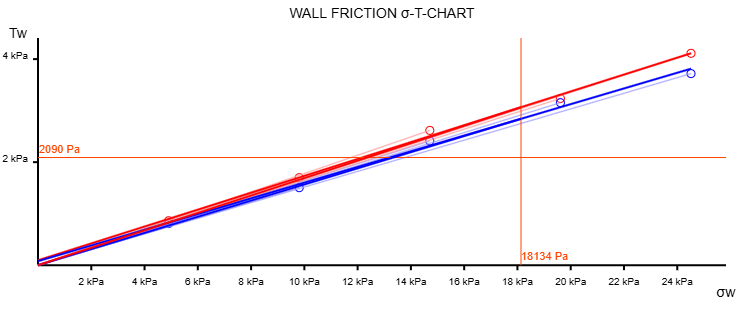
Static friction and dynamic friction
As with solid bodies, shearing on the wall first shows a stress peak, the static friction τw,s: it has to be overcome to set the bulk solid at rest on the wall in motion. After that, the bulk solid slides steadily at the dynamic friction τw,d, which is usually equal or smaller.
For the loads to EN 1991-4 the wall friction coefficient μ is determined from the residual value of the friction force at large deformations – i.e. from dynamic friction, at a reference stress corresponding to the largest horizontal pressure in the silo. The smaller angle of dynamic friction gives the larger pressures.
For technological design – start-up from rest, mass and funnel flow, arching – static friction is decisive instead, after storage also static friction after time consolidation.
Wall material and changes during operation
Wall samples with nominally the same designation can differ in wall friction by several degrees. The measurement on the material from which the silo is actually built is therefore what counts.
Wall surface categories to EN 1991-4
EN 1991-4 assigns wall surfaces to four categories: D1, very smooth (e.g. cold-rolled or polished stainless steel, aluminium), D2, smooth (e.g. carbon steel with light surface rust, galvanised steel), D3, rough (e.g. concrete, corroded carbon steel, ceramic tiles) and D4 for corrugated or profiled walls. The wall friction measured on your material replaces the classification via tabulated values.
Wall samples
We prefer to measure on a sample of your wall material with the intended surface finish or coating; we can cut it to size. For standard materials such as mild steel, stainless steel, various plastics, PTFE or ceramics we can provide wall samples. You receive the dimensions of the wall sample as a sketch with the quote.
Changes to the wall surface
Silo walls change during operation: corrosion roughens the surface, abrasion can roughen or polish it, plastics can be hollowed out and coatings scratched. Fines or fats from the bulk solid can fill pores and smooth the wall. This can change the flow pattern – a silo designed for mass flow turns into funnel flow or vice versa. On polished walls the filling loads increase, on roughened walls the wall friction loads.
Time consolidation on the wall
As with the yield locus, wall friction can also increase after a period at rest under load. We measure time consolidation on the wall as static friction after a defined period at rest. The procedure corresponds to that for the yield locus: the time test gives the time consolidation factor – the ratio of the wall shear stress with and without storage time – with which the increase is transferred proportionally to the wall yield loci. EN 1991-4 does not include time consolidation; for start-up after standstill and the flow pattern after storage it is often decisive.
Frequently asked questions about wall friction measurement
- Which wall sample is needed?
- The most meaningful is a sample of the material from which the silo or the hopper is built – with the intended surface finish or coating. We can cut it to size; you receive the dimensions as a sketch with the quote. For standard materials such as mild steel, stainless steel, various plastics, PTFE or ceramics we can provide wall samples.
- Which value is used for the silo calculation – static or dynamic friction?
- For the loads to EN 1991-4 the wall friction coefficient μ is determined from the residual value of the friction force at large deformations, i.e. from dynamic friction; the smaller angle of dynamic friction gives the larger pressures. For technological design – mass and funnel flow, arching, start-up after standstill – static friction is decisive, after storage also static friction after time consolidation.
- Can wall friction change during operation?
- Yes. Corrosion can roughen the surface, abrasion can roughen or polish it, fines or fats from the bulk solid can fill pores and smooth the wall. This can change the flow pattern – up to funnel flow in a silo designed for mass flow – and the silo loads shift. On request we simulate the shear loading of the wall surface over a defined period and then determine the change in the wall friction coefficient.
- How much sample material is needed?
- About 100 ml are needed per sample preparation. As each measurement is carried out at least in duplicate, about 200 to 300 ml per wall material are required for the wall friction measurement alone. If yield loci are measured as well, the quantity needed for them is added.
- How long does the measurement take?
- Results are usually available about two weeks after sample receipt – depending on laboratory capacity and the number of samples. Time consolidation tests can extend the standard lead time accordingly.
Have the wall friction measured
Tell us about your bulk solid and the intended wall material – we define the normal stresses and prepare a non-binding quote for you.
- Static and dynamic friction on your wall material or our standard samples
- Wall friction coefficient μ for the silo loads to EN 1991-4
- Results online in the customer portal and as a test report