
Time consolidation of bulk solids: measurement and parameters
Bulk solids can gain strength during storage at rest – under load, without being sheared. The causes are physical and chemical processes, e.g. crystallisation and sintering or chemical solid-state reactions.
From the time yield locus you obtain cohesion, unconfined compressive strength and flowability after a defined storage time – the basis for outlet and rathole after standstill and for choosing permissible storage times.
Parameters from time consolidation
Each time yield locus provides the parameters of the yield locus after the chosen storage time.
| Parameter | Symbol | Use |
|---|---|---|
| Time consolidation factor | – | transferring time consolidation to all yield loci |
| Increase in cohesion | Δτc | time yield locus from the instantaneous yield locus |
| Cohesion after storage time | τc + Δτc | flow behaviour after standstill |
| Unconfined compressive strength after storage time | σc,t | arching after standstill |
| Time flow function | σc,t(σ1) | arching and ratholing after storage time |
| Flowability after storage time | ffc,t = σ1 / σc,t | comparing bulk solids and storage times |
| Time consolidation function | τ(t) | choosing permissible storage and standstill times |
Carrying out the time consolidation measurement
Measurements are carried out on the same standardised shear testers to ASTM D6682-A as the yield locus – supplemented by time tests in which the sample rests under load for a defined time.
- Instantaneous yield locus First, the yield locus without storage time is measured.
- Storage time The consolidated sample rests under load for a defined time – from a few hours to several days, in the shear tester or outside it.
- Shear Then the maximum shear stress is measured and compared with the test without storage time – this gives the time consolidation factor.
- Time yield locus Via the time consolidation factor, the increase is transferred to all shear tests – giving the time yield loci.
Test series over the storage time
Several storage times give the time consolidation function: it shows how quickly the cohesion increases and whether it reaches a final value. The test series can range from a few hours to several days; we define it on the basis of the storage and standstill times of your plant. Unless requested otherwise, we measure time consolidation at the largest consolidation stress.
Loading during the storage time
If the shear cell remains in the shear tester – for storage times up to 24 hours – the sample stays under normal and shear force. For longer storage times, usually over 24 hours, the sample is stored outside the shear tester under a normal force corresponding to the major principal stress σ1 from the instantaneous shear test.
Time consolidation factor
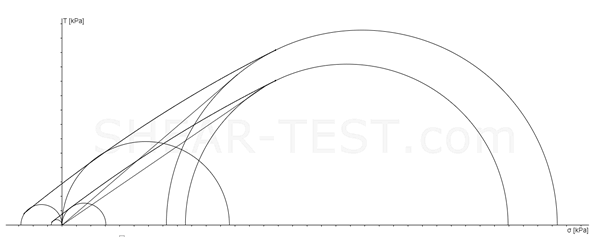
Time consolidation mainly increases the adhesive forces between the particles and thus the cohesion; particle friction, and with it the angle of internal friction, remain largely unchanged. The time test gives the time consolidation factor f – the ratio of the shear stress after the storage time to the shear stress without storage time. With it, the increase is transferred proportionally to the shear tests of all consolidation stresses: each yield locus is shifted by its Δτc, giving time yield loci and the time flow function – without a separate time test for each shear point.
This assumes that the relative increase in shear stress is the same for all consolidation stresses: each yield locus is shifted by Δτc = (f − 1) · τ, where τ is the shear stress at the pre-shear point of the respective yield locus. On request we measure time tests at further consolidation stresses.
The increase over the storage time is fitted logarithmically; this also gives the factor for storage times between the measurements.
Test report and customer portal
The test report contains the instantaneous yield locus and the time yield loci with all parameters. In the customer portal, different storage times and measurements can be set side by side and compared.
Influencing factors and effects of time consolidation
Influencing factors
How strongly a bulk solid consolidates over time depends on the material, on the normal stress during storage and on the storage duration. The increase usually reaches a final value after a material-specific period; after that, the cohesion hardly increases any further.
Wall friction after storage time
Friction on the wall can also increase after a period at rest – up to caking. We measure time consolidation on the wall as static friction after a defined period at rest and transfer it analogously to the wall yield loci via a time consolidation factor; it is decisive for start-up after standstill and the flow pattern after storage (wall friction).
Effects in the silo
With the cohesion, the unconfined compressive strength of the bulk solid at rest rises. An outlet that is sufficient in continuous operation can be too small after a standstill: arches and ratholes form more easily, and the silo no longer starts discharging by itself after the standstill.
Time consolidation and EN 1991-4
The load determination to EN 1991-4 does not include time consolidation. For technological design – outlet diameter, rathole diameter and permissible storage times – it is often decisive, however. With the time yield loci obtained via the time consolidation factor, the silo calculation can also be carried out under time consolidation.
Frequently asked questions about time consolidation
- Which storage times are measured?
- The test series can range from a few hours to several days; we define it on the basis of the storage and standstill times of your plant. Unless requested otherwise, time consolidation is measured at the largest consolidation stress.
- Does a separate time test have to be measured for each consolidation stress?
- No. The time test gives the time consolidation factor – the ratio of the shear stress after the storage time to the shear stress without storage time. With it, the increase due to time consolidation is transferred proportionally to the shear tests of all consolidation stresses. This produces time yield loci and the time flow function, and the silo calculation can also be carried out under time consolidation – without individual time tests for each shear point.
- Does EN 1991-4 take time consolidation into account?
- No, the load determination to EN 1991-4 does not include time consolidation. For technological design – arching and ratholing after standstill, start-up from rest, wall friction after storage – it is often decisive, however.
- How long does the measurement take?
- Results are usually available about two weeks after sample receipt – depending on laboratory capacity and the number of samples. Time consolidation tests can extend the standard lead time accordingly.
Have time consolidation measured
Tell us the storage and standstill times of your plant – we define the test series and prepare a non-binding quote for you.
- Time yield loci and time flow function σc,t(σ1) via the time consolidation factor
- Time consolidation on the wall
- Results online in the customer portal and as a test report