
Angle of repose of bulk solids: measurement and parameters
The angle of repose is the angle of inclination of a freely poured bulk solid cone relative to the horizontal. It describes the loose, uncompacted bulk solid.
For squat and intermediate-slenderness silos (hc/dc < 2) it enters into the silo loads to EN 1991-4; it also serves as a simple comparative value of flowability.
Parameters from the angle of repose measurement
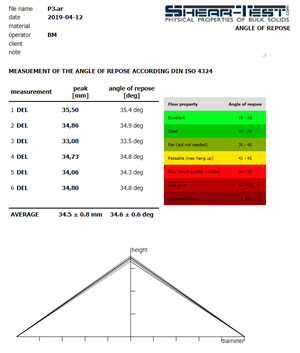
Each test series provides the individual values, their mean value and the scatter.
| Parameter | Symbol | in EN 1991-4 | Use |
|---|---|---|---|
| Angle of repose | φAR | φr | surface cone, silo loads of squat and intermediate-slenderness silos |
| Cone height | hpeak | – | calculation of the angle of repose |
| Mean value and standard deviation | φAR,avg, SDAR | – | comparing bulk solids and batches |
Carrying out the angle of repose measurement
Measurements are carried out to DIN ISO 4324 or ASTM D6393 under reproducible conditions so that the results are comparable.
- Pouring The bulk solid flows from a funnel onto a base plate of fixed diameter.
- Cone Pouring continues until the cone overflows the edge of the plate.
- Cone height The height of the cone tip above the plate is measured.
- Angle of repose Cone height and plate diameter give the angle of repose; the measurement is repeated several times.
Calculation
For a fixed plate diameter d and measured cone height h: tan φAR = 2h / d. The mean value and standard deviation are formed from the individual measurements.
Test report and customer portal
The test report contains all individual values with cone height and angle of repose, the mean value with standard deviation, the classification of flowability and the cone profiles. In the customer portal, different measurements can be set side by side and compared.
Angle of repose to EN 1991-4
Squat and intermediate-slenderness silos
During filling, a surface cone forms in the silo. Its height depends on the angle of repose φr and on the position of the filling point and determines the equivalent surface of the stored solid, from which the filling pressures are calculated. In slender silos this contribution is small, in squat and intermediate-slenderness silos (hc/dc < 2), however, it is decisive – there we therefore determine the angle of repose in addition to the parameters for silo design.
Coarse bulk solids without fines
For coarse bulk solids without fines, such as peas, beans or potatoes, wall friction and internal friction cannot readily be determined. EN 1991-4 then takes the angle of repose of a loosely poured cone as the angle of internal friction.
Angle of repose and shear test
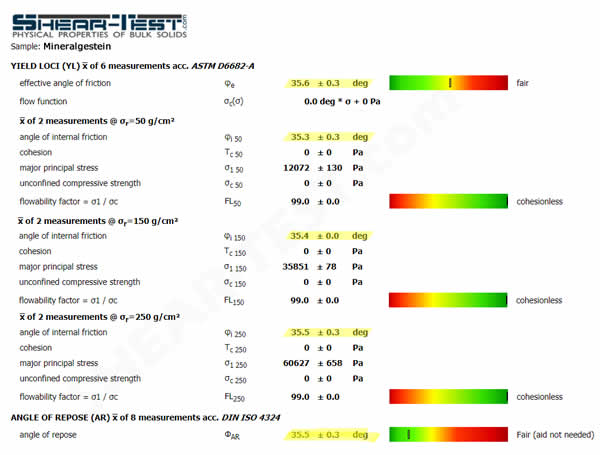
For free-flowing, cohesionless bulk solids, the angle of repose corresponds to the angle of internal friction and the effective angle of internal friction from the yield locus. Among other things, this can be used to validate a shear tester.
Classification of flowability by the angle of repose
The smaller the angle of repose, the better the loose bulk solid flows. The usual classification to USP 1174, as also stated in the test report:
| Angle of repose | Flow property |
|---|---|
| 25 – 30° | excellent |
| 31 – 35° | good |
| 36 – 40° | fair – aid not needed |
| 41 – 45° | passable – may hang up |
| 46 – 55° | poor – must agitate, vibrate |
| 56 – 65° | very poor |
| ≥ 66° | very, very poor |
For silo design and the assessment of flow problems of cohesive bulk solids, the angle of repose does not replace the measurement of the yield locus and the flowability ffc.
Frequently asked questions about angle of repose measurement
- When is the angle of repose needed for silo design?
- For squat and intermediate-slenderness silos (hc/dc < 2): there the surface cone determines the position of the equivalent surface of the stored solid and thus the silo loads to EN 1991-4. For coarse bulk solids without fines, such as peas, beans or potatoes, the standard also takes the angle of repose as the angle of internal friction.
- Does the angle of repose replace the yield locus measurement?
- No. The angle of repose describes the loose, uncompacted bulk solid. For free-flowing, cohesionless bulk solids it agrees with the angle of internal friction and the effective angle of internal friction from the yield locus. For cohesive bulk solids, however, the flow behaviour depends on the consolidation – silo loads, mass flow and arching are therefore determined from the yield locus.
- How often is the angle of repose measured?
- The measurement is repeated several times; the test report contains all individual values, the mean value and the standard deviation.
- How long does the measurement take?
- Results are usually available about two weeks after sample receipt – depending on laboratory capacity and the number of samples. Time consolidation tests can extend the standard lead time accordingly.
Have the angle of repose measured
Describe your bulk solid and the application – we prepare a non-binding quote for you, on request together with the parameters for silo design.
- Angle of repose to DIN ISO 4324 or ASTM D6393
- Angle of repose φr for squat and intermediate-slenderness silos
- Results online in the customer portal and as a test report